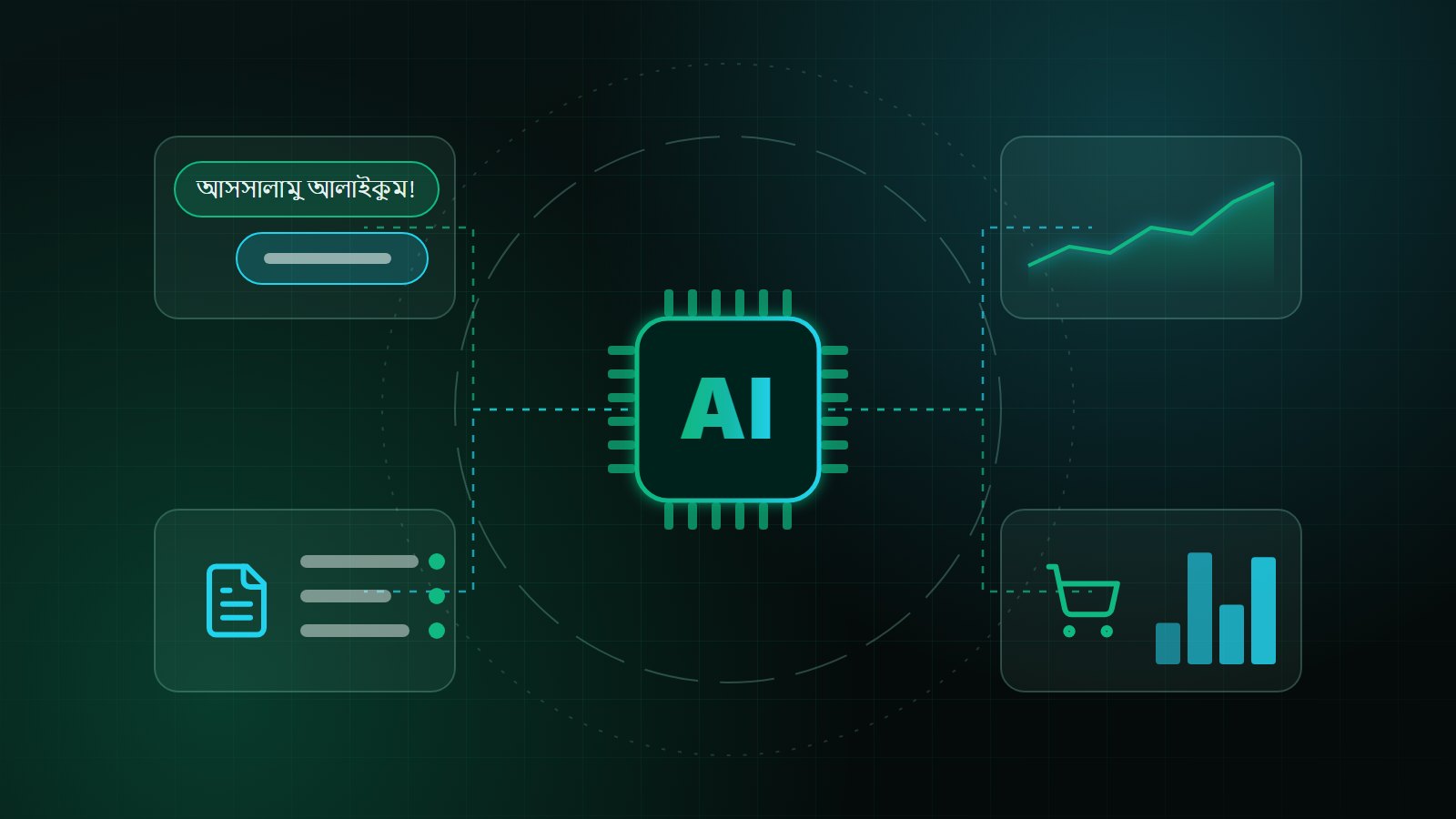
Artificial intelligence is no longer only for global technology companies. Thanks to cloud services and ready-made AI models, small and medium businesses in Bangladesh, from shops in Dhaka to distributors in Chattogram and NGOs working across the districts, can now use AI to save time, reduce costs and serve customers better, often on top of the software they already have.
Key takeaways
- The quickest wins are AI chatbots for customer questions, reading documents automatically, and forecasting demand.
- AI can now understand and reply in Bangla as well as English.
- Start with one clear, measurable problem and the data you already have.
- Add AI to your existing systems rather than replacing them, and keep people in the loop.
1. Answer customer questions automatically, in Bangla and English
Many businesses get the same questions every day on Facebook Messenger, WhatsApp and the phone: prices, stock, delivery charges, order status. An AI chatbot can answer these instantly, in Bangla or English, at any hour, and hand complex questions to a person.
Good fit for: f-commerce sellers, retail shops, clinics, training centers and service companies.
2. Turn paper documents into data
Invoices, delivery challans, purchase orders, prescriptions and forms often arrive as paper or PDFs. Document intelligence (OCR combined with AI) can read these documents, extract the important fields and enter them into your accounting or ERP software.
Good fit for: accounts departments, distributors, hospitals and NGOs handling large volumes of forms.
3. Forecast demand and plan stock
If you keep sales records, AI can learn the patterns in them: the rush before Eid and Pohela Boishakh, monthly salary-day peaks, weather effects and the impact of promotions. It then forecasts demand for the coming weeks, helping you avoid both stock-outs and money tied up in slow-moving inventory.
Good fit for: retailers, pharmacies, wholesalers, garment suppliers and manufacturers.
4. Automate repetitive workflows
Approvals, data entry, daily reports and payment reminders take up a surprising amount of staff time. Intelligent automation combines business rules with AI so these tasks run on their own, while people focus on decisions and customers.
5. Get insight from your data
Most businesses already collect valuable data in their software but rarely analyze it. AI-powered dashboards can highlight trends, unusual transactions and opportunities, and let managers ask questions in plain language.
Common mistakes to avoid
- Starting too big. A company-wide "AI transformation" usually stalls. One focused pilot builds confidence.
- Ignoring data quality. If product names, customer records or prices are inconsistent, clean them first.
- No owner. Someone in the business must own the AI project and its results.
- Forgetting privacy. Customer and patient data must be handled securely, with clear access controls.
- Removing human review too early. Let staff check AI output, especially in finance and healthcare, until it has proven reliable.
How to get started
- Pick one problem that is repetitive, time-consuming and measurable.
- Check your data: even a year of sales records or a few hundred documents is a good start.
- Run a pilot for a few weeks and measure the result in time or money saved.
- Integrate the AI with the software your team already uses.
- Expand to the next use case once the first one delivers.
Frequently asked questions
Is AI too expensive for a small business?
Not necessarily. Many AI capabilities are available as pay-as-you-go cloud services, so you pay for what you use. The main investment is in connecting AI securely to your data and processes.
Can an AI chatbot reply in Bangla?
Yes. Modern AI models understand and write Bangla, and can switch between Bangla and English depending on how the customer writes.
Will AI replace our staff?
In most small and medium businesses, AI takes over repetitive tasks such as typing, sorting and answering routine questions, so staff can spend more time on customers, sales and decisions.
Is our business data safe?
It can be, with the right setup: secure hosting, access controls and clear rules about what data the AI may use. Ask your provider exactly where your data is stored and who can see it.
Next step
Curious which AI use case would give your business the clearest return? Explore our AI & Machine Learning Solutions or contact us for a free consultation.